
The Best Snow Pusher for Driveways
Clear your driveway faster with a snow pusher that slides snow instead of lifting it. Our research highlights top picks with wide blades, comfortable handles, and wheeled models for easy pushing in 2026.
 By Harry
Updated October 12, 2026
Shoveling a long driveway after a heavy snowfall is hard on your back, and a standard shovel can turn a quick clearing session into an hour of repeated lifting.
A snow pusher changes the job by letting you slide snow forward without scooping, which saves energy and reduces strain. This article identifies the best snow pusher for driveways available in 2026.
Snow Removal Wiki uses a research-driven approach: we evaluate specifications, expert review consensus, verified buyer feedback, and published data to score each product on our 0 to 10 SRW Score.
We don’t carry out our own product trials, but we analyze what owners and trusted reviewers say to recommend reliable tools for different driveway sizes and snow conditions. Below you will find our top-rated picks.
| Award | Product | SRW Score About SRW ScoreThe SRW Score is our own rating from 0 to 10, based on performance, design and build, ease of use, and value. It reflects independent research and is never influenced by manufacturers, retailers, or affiliate commissions. Learn more › | |
|---|---|---|---|
| Best Overall |
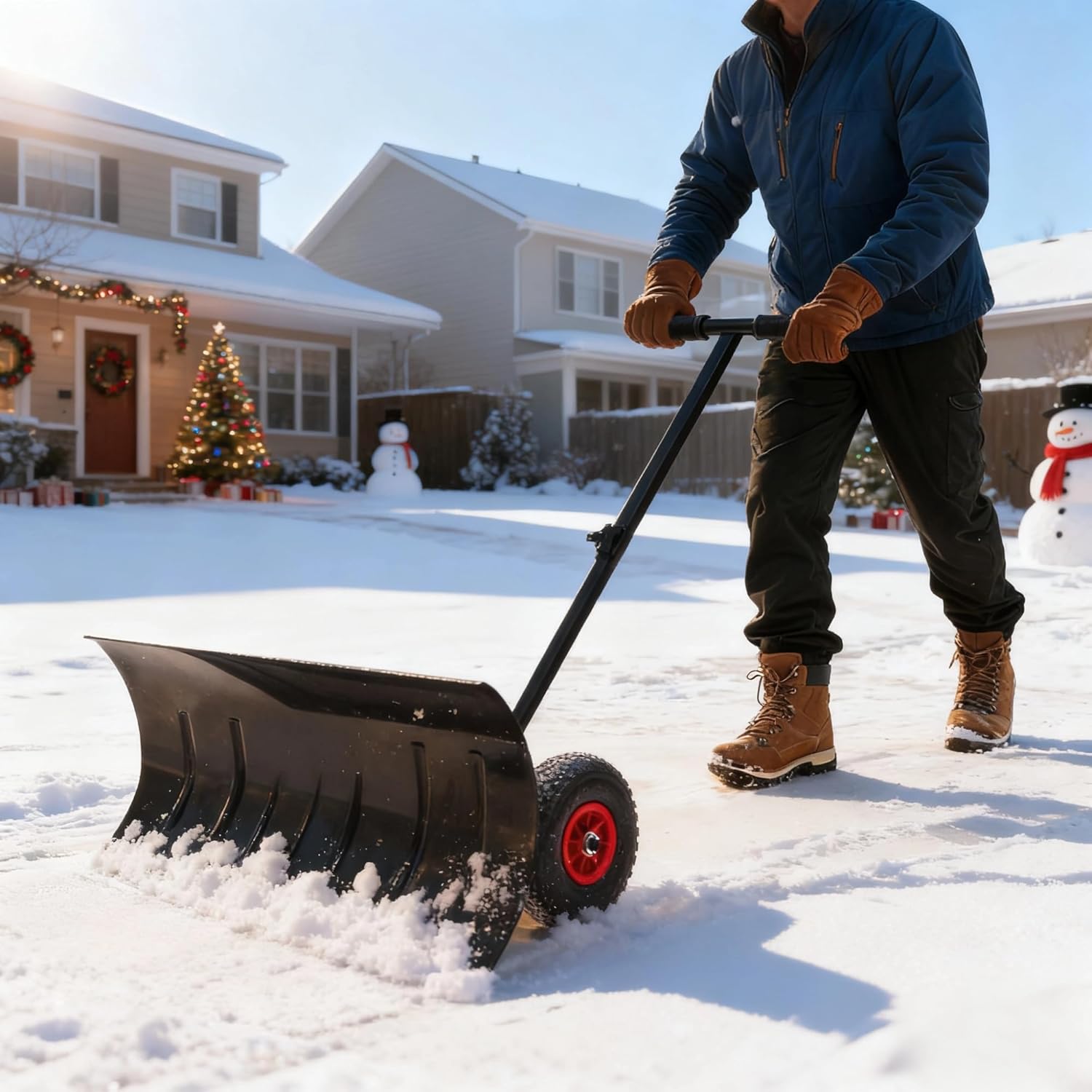 Garvee Heavy Duty Steel Snow Shovel Pusher |
9.4/10 | Buy |
| Best Budget |
 The Snowplow Original Snow Pusher 36 inch |
8.8/10 | Buy |
 Avalanche! AVA500 15.5' Roof Snow Rake |
8.4/10 | Buy |
Garvee Heavy Duty Steel Snow Shovel Pusher
Effective Snow Removal: A 29-inch-wide blade with smoothly rolling wheels makes cleaning your driveway, sidewalk or walkway a breeze! It can also clear snow from your garden or courtyard. Adjustable Blade Angle: The 29-inch wide metal blade is highly flexible. It incorporates a 5-hole adjustable design, allowing bidirectional adjustment up to 45 degrees or fixation at a preferred angle. The nylon slider located at the base of the metal blade is capable of efficiently removing up to 5 inches of compacted snow or 10 inches of loose snow in a single pass. This snow removal mechanism operates at a speed four times greater than that of a conventional snow shovel. 5 Adjustable Handle Heights: To make snow removal comfortable for people of different heights, the handle is designed with an adjustable structure that can be set at 15.74/27.55/35.43/42.12/45.67in (40/70/90/107/116cm). Clearing snow has never been easier.
The Snowplow Original Snow Pusher 36 inch
This 36-inch snow pusher from The Snowplow is built for efficient snow removal on flat surfaces. Its virgin UHMW polyethylene blade resists sticking and wears well, while the patented TUFFBRACE handle system adds durability. Best suited for light to moderate snow, it excels on concrete and pavers but may struggle on uneven ground.
Pros
- Non-stick UHMW blade prevents snow buildup and reduces effort
- Sturdy construction with reinforced metal handle and patented TUFFBRACE
- Ergonomic D-grip design for comfortable use
- Effective for clearing large areas quickly in a single pass
- Made in USA with high-quality materials
Cons
- Blade catches on uneven surfaces, limiting use to smooth areas
- Best performance limited to light to moderate snow (under 3-5 inches)
- Premium price point may not suit all budgets
Avalanche! AVA500 15.5' Roof Snow Rake
For homeowners needing to clear snow from asphalt shingle roofs without damage, the Avalanche! AVA500 uses a lightweight fiberglass pole and a plastic slide with wheels to glide over shingles. Its snap-together assembly makes setup quick, and the 15.5-foot reach lets you work from the ground.
Pros
- Lightweight fiberglass pole reduces fatigue
- Snap-together assembly for quick setup
- Wheels protect asphalt shingles from damage
Cons
- Plastic slide may be less durable than metal alternatives
- 15.5-foot pole may be insufficient for very high roofs
Best Snow Pusher for Driveways Buying Guide
Blade Width and Driveway Coverage
Blade width is the main factor that determines how quickly you can clear a driveway. A wider blade, typically in the 36-inch range, covers more ground per pass and cuts down total clearing time.
Narrower blades around 24 to 30 inches are easier to maneuver in tight spaces and around cars, but they require more passes on a two-car driveway.
Consider the layout of your driveway before choosing a width. If you have a straight, open expanse of pavement with few obstacles, a wide pusher is the most efficient option.
For a shorter driveway or one with sharp turns, a more compact blade gives you better control without feeling unwieldy, especially when pushing heavy, wet snow.
Think about pairing your snow pusher with a reliable machine for deeper accumulation. Many homeowners use a pusher for the final pass after a gas snow thrower has broken through the hard-packed layer, or for clearing a path to the garage before starting the blower.
Handle Design and Ergonomics
An ergonomic handle reduces the strain that comes from pushing snow for long stretches. Look for a handle that reaches your mid-chest or waist without forcing you to bend deeply.
Adjustable handles are particularly valuable because they let different family members set the height that feels natural for them.
Some pushers use a D-style grip or a reinforced brace that gives you two-handed leverage. This design helps you keep your back straight and transfer power from your legs rather than relying on your lower back.
A well-designed handle can make a 30-minute clearing job feel much less taxing.
The material of the handle also affects comfort. Steel handles are sturdy and withstand heavy use, while aluminum or composite options are lighter and easier to lift when you need to tilt the blade over a curb.
For older adults or anyone with limited mobility, a lightweight pusher with a comfortable grip is a practical choice, similar to the ergonomic thinking behind the easiest snow blower for seniors.
Blade Material and Durability
Snow pusher blades are usually made from steel, aluminum, or heavy-duty plastic. Steel blades are the most durable and can scrape ice and compacted snow without bending.
They also add weight, which can help the blade stay down on the pavement and prevent it from riding up over a thick snow layer.
Polymer blades are lighter and easier to slide across surfaces, but they are more prone to cracking in extreme cold if you hit an uneven expansion joint or a curb.
For most driveways, a steel blade with a reinforced wear strip or a coated edge provides the best balance of durability and glide, especially when clearing snow that refroze overnight.
A quality blade that resists rust and impact damage will last many winters.
If you are clearing a large area, you might also use a pusher alongside a snow blower for lake effect snow, where the heavier, dense snow benefits from a sturdy blade that won’t flex under pressure.
Weight and Push Effort
The weight of a snow pusher affects how much energy you need to move it forward.
A heavier unit presses down harder, which helps scrape ice, but it also increases the pushing force required, particularly if you are moving wet snow uphill.
A lightweight pusher is easier to manage for quick cleanups but may not bite into hard-packed snow as effectively.
Some pushers include wheels to reduce friction and make pushing feel nearly effortless. A wheeled design lifts the blade slightly off the pavement and lets you roll the tool forward instead of grinding it along the surface.
This is a significant advantage for longer driveways or for anyone who wants to avoid the strain of a traditional sliding blade.
Before you buy, consider how much snow your region receives and how often you clear your driveway. For a light dusting or a short walkway, a simple manual pusher might be all you need.
For heavier snowfall, investing in a model with wheels or a wider blade can save you from extra trips and reduce fatigue, similar to how a budget snow blower under 200 can handle smaller jobs without the bulk of a full-size machine.
Versatility and Multi-Surface Use
Many snow pushers work on more than just driveways. A 29-inch blade is still compact enough for sidewalks and walkways, while larger 36-inch models are best reserved for open pavement.
Check whether the blade has a straight edge for scraping or a curved design that helps direct snow to the side as you push.
If your property includes a gravel path or a brick paver patio, a steel blade might catch on the surface and cause damage.
A rubber or polymer edge is gentler and allows you to use the same tool on multiple surfaces without worrying about scratching.
Reviewing an ice melt solution for black ice can also help you decide whether you need a pusher that handles slush well or one that only moves dry powder.
A great pusher is not meant to replace a snow blower for deep, drifted snow. Instead, it fills the gap for lighter accumulations and for cleaning up after the blower has passed.
Pairing a pusher with a reliable snow blower brand gives you a complete winter maintenance kit.
Why You Should Trust Us
Snow Removal Wiki is an independent review site that follows a research-based methodology. We do not conduct our own product trials; our evaluations are grounded in research, published data, expert review consensus, and verified buyer feedback.
This approach lets us provide consistent, transparent guidance without the bias of a single direct session.
Every product we recommend is scored on our 0 to 10 SRW Score. We evaluate each model against the same criteria: blade construction, handle ergonomics, ease of pushing, durability, and overall value based on owner experiences and expert assessments.
We analyze hundreds of verified reviews and cross-check them with published specifications to make sure our recommendations reflect real-world performance.
We are transparent about how we make money: our site contains affiliate links, and we may earn a commission when you buy through those links. This does not influence our ratings or the order of our picks.
Our editorial team remains independent, and we never accept payment for favorable coverage.
Final Thoughts
Choosing the right snow pusher for your driveway depends on your specific needs, including how much snow you typically receive, the size of your driveway, and your physical comfort.
Our top picks represent the best combinations of durability, ease of use, and value that we found through our research.
- Best Overall: Garvee Heavy Duty Steel Snow Shovel Pusher with Wheels earned the highest SRW Score in our group. Its wheeled design, adjustable handle, and angled blade make it the most comfortable and effective option for clearing a wide range of driveways without lifting.
- Best for Wide Driveways: The Snowplow the Original Snow Pusher 36″ Wide Model is a close runner-up that excels at moving large volumes of snow with each pass. Its simple, proven build is ideal for straight, open pavement.
- Best for Reaching Snow on Roofs: Avalanche! Roof Snow Rake is a specialized tool that helps prevent ice dams and removes snow from roof edges, making it a useful complement to a driveway pusher for protecting your home.
Whichever model you choose, remember that a good snow pusher should make your winter routine easier and safer.
For lighter jobs where you need a quick solution, a pusher can be the only tool you need, especially when you already have a single stage vs two stage vs three stage snow blower comparison in mind for deeper snow.
Frequently Asked Questions
What is the difference between a snow pusher and a snow shovel?
A snow shovel is designed to scoop, lift, and throw snow away from a surface, while a snow pusher is meant to slide snow forward in a straight line without lifting.
Pushers typically have a wider, flatter blade and are used for clearing large driveways, whereas shovels are better for sidewalks, steps, and areas where you need to move snow to the side.
Using a pusher on a large driveway is much easier on your back because you don’t repeatedly lift heavy loads.
For deeper snow, some homeowners use a pusher first to slide the snow to the end of the driveway and then a shovel or blower to move it out of the way.
How wide of a snow pusher do I need for a two-car driveway?
A 36-inch wide pusher is usually a good fit for a standard two-car driveway because it covers a large area with each pass.
If your driveway has tight corners, parked cars, or a narrow apron, a 29-inch or 30-inch model gives you more agility and makes it easier to maneuver around obstacles.
Keep in mind that a wider blade also requires more effort to push, especially when the snow is wet and heavy. If you prefer a lighter load, choose a 29-inch model with wheels to reduce friction and make pushing feel less straining.
Can I use a snow pusher on gravel or brick surfaces?
You should be cautious when using a steel pusher on gravel or brick because the metal edge can catch on loose stones or scratch the surface.
A rubber or polymer blade is a better option for these materials because it glides over them without causing damage.
For a gravel driveway, you may prefer to use a lightweight pusher that doesn’t dig into the ground, or you could use a snow blower that can handle mixed surfaces.
If you already own a snow blower for ice, you can use it for the hard-packed sections and reserve your pusher for the smoother pavement.
Do wheeled snow pushers work as well as traditional sliding pushers?
Wheeled snow pushers are very effective and offer a significant advantage: they reduce friction, which makes pushing easier and prevents the blade from digging into the pavement.
The wheels help support the weight of the blade, so you can push for longer periods without getting tired.
A traditional sliding pusher relies on the blade scraping directly against the surface, which can be more effective at removing ice but requires more physical effort. For most residential driveways, a wheeled model is a great choice because it balances performance with comfort.
How do I maintain my snow pusher for winter?
After each use, shake off loose snow and store the pusher in a dry area to prevent rust, especially if it has a steel blade.
Apply a light coat of lubricant or a silicone spray to the blade edge to help snow slide off and to protect the metal.
Check the handle and blade connections periodically for loose bolts or cracks. A well-maintained pusher can last many years, just like a properly cared for snow blower that lasts longer when you follow a regular maintenance routine.
Can a snow pusher replace a snow blower?
A snow pusher cannot fully replace a snow blower for deep, heavy snowfalls.
A pusher is ideal for light to moderate snow, for final clean-up passes, and for keeping a driveway clear without the noise and expense of a motorized machine.
When a storm drops more than a few inches of wet snow, a snow blower is significantly faster and less physically demanding.
If you have a small driveway and are willing to clear snow shortly after it falls, a quality pusher may be all you need. For larger areas or frequent heavy snow, check out our snow blower clearance deals to find an affordable motorized option.
About the author

Harry writes reviews and buying guides for Snow Removal Wiki.