
The Best Walk Behind Salt Spreader
The best walk behind salt spreader saves time on icy driveways. We compared capacity, frame durability, and spread control to find the right fit.
 By Harry
Updated October 10, 2026
Winter maintenance is rarely one task. While a full-size snow blower handles deep drifts, the ice that forms after a thaw needs an even layer of salt or ice melt.
A walk behind salt spreader makes that job repeatable, neat, and much faster than tossing handfuls by hand.
The best walk behind salt spreader balances hopper capacity, spreading width, and durable construction so you can treat a driveway, walkway, or parking pad without waste.
Snow Removal Wiki researches each model using published specifications, expert review consensus, and verified buyer feedback. We organize those results into a clear comparison for homeowners, then outline what to look for before you buy.
Below are the top contenders, followed by a practical buying guide for choosing the right spreader for your property.
| Award | Product | SRW Score About SRW ScoreThe SRW Score is our own rating from 0 to 10, based on performance, design and build, ease of use, and value. It reflects independent research and is never influenced by manufacturers, retailers, or affiliate commissions. Learn more › | |
|---|---|---|---|
| Best Overall |
 VEVOR TC2136 80-lb Walk-Behind Spreader |
8.1/10 | Buy |
| Best Budget |
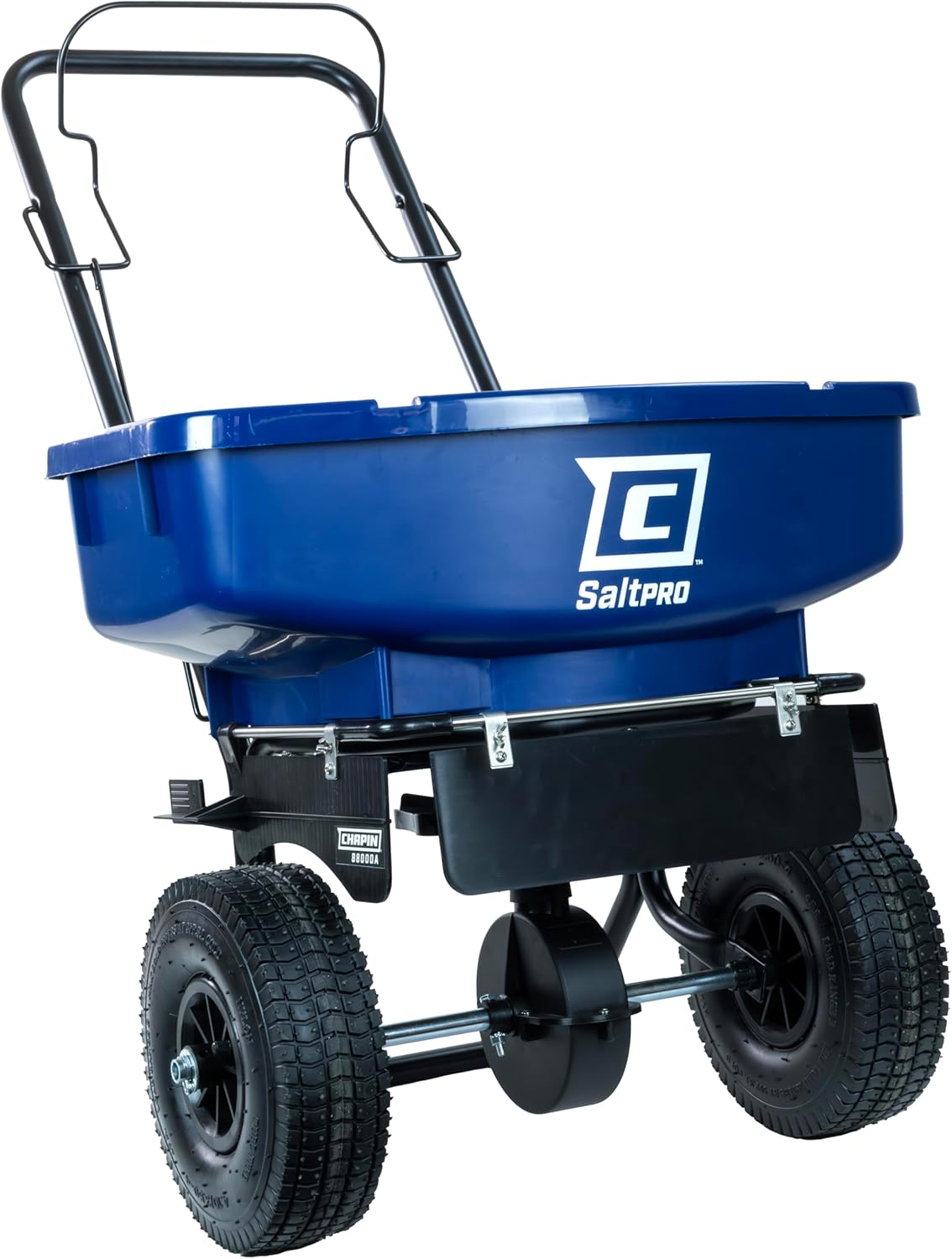 CHAPIN 88000A SaltPro 80 lb Salt Spreader |
7.8/10 | Buy |
| Best Value |
 Agri-Fab 45-0614 130 lb. Push Lawn & Garden |
7.8/10 | Buy |
| Best Premium |
 SaltDogg WB155BG 100 lb Walk Behind Salt Spreader |
7.6/10 | Buy |
 Buyers Products 3039632R 100 lb All-Season |
7.5/10 | Buy |
VEVOR TC2136 80-lb Walk-Behind Spreader
The VEVOR TC2136 is a walk-behind broadcast spreader with an 80-pound hopper and 12-foot spreading width. It offers 15 adjustable settings for precise distribution of seeds, fertilizer, and ice melt. Its powder-coated steel frame and pneumatic tires make it suitable for various terrains, and the tool-free assembly appeals to first-time users.
Pros
- 12-ft spreading width with 15 adjustable settings for precise application
- 80-lb hopper reduces refill frequency
- Durable powder-coated steel frame and explosion-proof hopper
- 10-inch pneumatic tires handle uneven terrain
- Easy assembly with pre-assembled components
CHAPIN 88000A SaltPro 80 lb Salt Spreader
Chapin's 88000A 80-Pound SaltPro Residential Spreader with Baffles and 10" pnuematic tires is great for residential use to melt snow and ice
Agri-Fab 45-0614 130 lb. Push Lawn & Garden
Agri-Fab 45-0614 130 lb. Push Lawn & Garden Broadcast Spreader for Seed,Fertilizer,Salt,Ice Melt; Walk Behind with Easy to use Flow Control Lever
SaltDogg WB155BG 100 lb Walk Behind Salt Spreader
The SaltDogg WB155BG is a 100 lb walk behind broadcast spreader with a steel frame, designed for clearing sidewalks, walkways, and small lots. Owner reviews describe it as sturdy and say it throws salt well once moving, though it takes some effort to push when the hopper is full. It suits small businesses that handle their own salting as well as homeowners with larger pavement.
Pros
- 100 lb hopper capacity for walk behind use
- Steel frame adds durability
- Owner reviews describe it as sturdy and effective at throwing salt
Cons
- Hard to push when fully loaded, especially at the start
- One owner reported the stand and salt lever broke on the second use, raising durability concerns
Buyers Products 3039632R 100 lb All-Season
Handle year-round grounds maintenance with the Buyers Products 3039632R Grounds Keeper Walk-Behind Broadcast Spreader. Built for property managers, contractors, institutions, and demanding residential users, this versatile spreader carries up to 100 lb of compatible material for efficient coverage with fewer refills. Use it for grass seed and fertilizer in warmer seasons, then transition to bagged salt or ice melt when winter conditions arrive. The axle-driven spinner distributes material across a pattern up to 24 feet wide, while the simple flow-control lever and adjustable poly deflectors help direct material and reduce unwanted application near garden beds, curbs, or surrounding surfaces. A rust-resistant poly hopper pairs with a fully welded, powder-coated carbon steel frame for dependable service. The enclosed gearbox, grease fitting, and commercial-grade alloy gears help protect the drive system from weather, rust, and cold. Large 13-inch pneumatic tires support smooth movement across varied terrain. A hopper screen and nylon rain cover are included to help maintain material flow and protect the load. Before use, confirm the spinner-disc set screw is tight, adjust the flow for the selected material, and follow the material manufacturer's application guidance. Empty and rinse the spreader after using salt, ice melt, or fertilizer to reduce corrosive residue.
Best Walk Behind Salt Spreader Buying Guide
Hopper Capacity and Coverage
The first decision is hopper size. A smaller unit holds enough ice melt for a typical two-car driveway, while a larger hopper cuts down refill trips on long or winding driveways.
If you only clear a compact front pad, you can stay light and keep the unit easy to store; for more demanding layouts, a larger hopper is worth the extra weight.
Capacity also affects how much time you spend filling and how evenly you can finish the job. Overloading a spreader can make the frame flex, so choose a rating that matches your property.
Homeowners with short driveways often prefer a lighter unit, and that same logic applies to compact snow blowers for short driveways.
Broadcast Pattern and Adjustable Flow
A broadcast spreader flings material in a wide arc, so the pattern should be predictable and easy to control. Look for a flow lever that lets you adjust the opening without stopping.
This is especially important when switching from bare pavement to icy patches, because too much salt wastes product and can damage vegetation.
Wider patterns cover a driveway faster but require more precision near edges. If you regularly deal with wet, heavy snowfall before salting, pairing the spreader with a heavy wet snow thrower gives you a complete storm response.
For sloped ground, a controlled pattern is just as important as an even walking pace; hillside snow blowers follow the same principle of steady, controlled passes.
Frame, Tires, and Maneuverability
Salt and ice melt are heavy and corrosive, so the frame material matters. Powder-coated steel frames resist rust better than basic plastic hoppers, and a wide wheelbase keeps the spreader stable while you push.
Look for handles positioned at a comfortable height, plus a parking brake or stand so the unit stays upright when you set it down.
Tire size and tread determine how easily the spreader rolls over packed snow and uneven pavement. Larger all-terrain tires, often around 10 inches, handle deeper snow better than small wheels.
If you already prefer powered assistance when clearing snow, self-propelled snow blowers remain the best choice for the main snow pile, while a simple push spreader can handle the salt layer.
Material Build and Winter Durability
A spreader sits in freezing temperatures and comes into contact with calcium chloride and rock salt, which accelerate corrosion. Stainless steel or coated steel components last longer, and a hopper that can be removed for cleaning makes maintenance easier.
Plastic hoppers are lighter, but they need thick walls to survive rough handling.
Check how the shut-off mechanism works. A positive shut-off that closes completely prevents salt from leaking out while you carry or store the spreader.
When you spend long stretches outside, comfort features matter too, so consider something like heated hand grips for your snow equipment routine.
Ease of Setup and Maintenance
Most walk behind salt spreader units require only basic assembly: attach the handle, mount the wheels, and secure the hopper. Tool-free assembly is a plus if you plan to break the unit down for storage between seasons.
Look for a flow control lever that you can reach without bending, and check whether the hopper screen or deflector removes easily for cleaning.
Maintenance matters because salt residue hides in axles and wheel bearings. Rinse the frame after use, especially in coastal areas or after a long winter.
If you are starting from scratch with your snow removal fleet, a 56V snow blower covers clearing, while this spreader keeps traction down afterward.
Matching the Spreader to Your Storm Routine
No single model fits every property. A 100 lb spreader suits most suburban driveways, while a 130 lb hopper is better for longer gravel lanes.
If you plan to use the same unit for fertilizer and seed in warmer months, choose a versatile broadcast spreader with easily adjustable settings.
Think about how this tool fits your existing workflow. If you already own a snow blower, the spreader is the second half of the job.
For people buying multiple tools at once, it makes sense to research the cheapest time to buy a snow blower before checking out the full winter setup.
Why You Should Trust Us
Snow Removal Wiki is an independent review site focused on winter maintenance. Each product in the roundup receives an SRW Score on a 0 to 10 scale, based on a consistent evaluation framework.
That framework combines published specifications, expert review consensus, and verified buyer feedback, rather than a single opinion.
We assess spreaders the same way we approach snow thrower ratings: we look for balanced performance across the criteria that matter most to homeowners.
Because snow removal needs vary by climate and property size, we also account for value, durability, and ease of use. For those interested in electric options, our battery-powered snow blower lineup explains how different power sources change the clearing experience.
We do not conduct our own product trials; our evaluations are grounded in research, published data, expert review consensus, and verified buyer feedback. We update articles as manufacturers revise models and as new buyer feedback appears, so the recommendations stay relevant for the current season.
Final Thoughts
Choosing the best walk behind salt spreader comes down to matching the hopper, frame, and spreading pattern to your property. The picks in this roundup cover the main use cases, and each one earned an SRW Score from our evaluation process.
Best Overall: VEVOR Push Lawn Spreader combines an 80 lb capacity, 12 foot spreading width, and 15 adjustable settings, making it the most balanced choice for residential driveways and garden tasks. It earned the highest SRW Score in this comparison thanks to its versatility and low-fuss design.
Best for Larger Properties: Agri-Fab 45-0614 Push Spreader carries a 130 lb hopper, so it handles longer driveways and repeated applications without constant refills. The easy flow control lever gives you a wide adjustment range for different ice melt granules.
Best Value Pick: CHAPIN SaltPro 80 lb Spreader delivers reliable spreading at an approachable price, with 10 inch tires and a compact footprint. For budget-conscious buyers, it offers the best combination of cost and daily usability in this group.
Best Professional-Grade Option: SaltDogg 100 lb Walk-Behind Salt Spreader uses a steel frame and a proven broadcast system for frequent winter use. It is the pick for homeowners who want commercial-style durability from a hand-pushed unit.
Best All-Season Spreader: Buyers Products 100 lb All-Season Walk-Behind Broadcast Spreader adds a flexible option for homeowners who want one tool for salt, fertilizer, and seed. Its straightforward controls and sturdy build make it a dependable addition to a winter tool shed.
Frequently Asked Questions
How much salt or ice melt should a walk behind salt spreader hold?
For a two-car driveway, an 80 to 100 lb hopper is usually enough for a few passes. Longer driveways benefit from a 130 lb capacity so you can finish the whole route without refilling.
If you clear a very long private road, a snow blower built for long driveways will handle the snow while the spreader handles traction.
Can I use the same spreader for salt, fertilizer, and seed?
Many broadcast spreaders work for all three materials, but you should rinse the hopper and frame after using salt before switching to lawn products. Salt residue can harm grass and corrode the spreading mechanism.
Models with adjustable flow are easier to switch between coarse ice melt and fine seed.
How wide should the spreading pattern be for a driveway?
Most walk behind spreaders cover a 6 to 12 foot path, which is ideal for standard driveways. A wider pattern saves time but requires careful walking to avoid throwing salt onto grass.
If your property has a steep slope, a narrower gap and a calm pace produce a more even layer.
Are steel-frame spreaders worth the extra cost?
Yes for frequent use in harsh winters. Steel frames resist bending under a heavy load, and powder coating protects against salt corrosion.
Budget buyers can still find capable units with durable plastic hoppers, but affordable snow blowers and spreaders both show the same tradeoff: lighter materials save money, while heavier materials feel more stable over time.
What maintenance does a salt spreader need after winter?
Empty the hopper completely, brush off loose salt, and wipe the metal surfaces with a damp cloth. Lubricate the axle and moving parts before storage, and keep the unit indoors if possible.
A few minutes of care prevents rust from turning a winter workhorse into a one-season tool.
When should I apply ice melt with a walk behind spreader?
Apply before ice bonds to the pavement, especially before a storm or when temperatures drop overnight. A light, even layer is more effective than a heavy clump of salt. Spreaders let you control that layer precisely, which reduces waste and keeps walkways safe.
About the author

Harry writes reviews and buying guides for Snow Removal Wiki.