
The Best Salt Spreader for Commercial Use
Our research-based guide covers the top salt spreaders for commercial use, from walk-behind models to handheld units, with expert consensus and buyer feedback to help you choose.
 By Harry
Updated October 10, 2026
Keeping parking lots, sidewalks, and driveways clear of ice and snow is a critical task for property managers, contractors, and business owners. A reliable salt spreader ensures you apply ice melt efficiently, saving time and material costs while maintaining safety.
In this article, we evaluate the top models on the market, drawing on expert consensus, verified buyer feedback, and published specifications to help you choose the best salt spreader for commercial use for your operation.
Our team has scored each product on a consistent 0, 10 SRW Score to give you a clear, data-backed recommendation. Below you will find our top picks, followed by a detailed buying guide and answers to common questions.
Whether you need a walk-behind unit for large lots or a compact handheld for quick touch-ups, the right spreader can make winter maintenance far more manageable.
We have researched dozens of models and narrowed the list to six that stand out in terms of durability, coverage, and ease of use. Let us walk you through the best options available.
| Award | Product | SRW Score About SRW ScoreThe SRW Score is our own rating from 0 to 10, based on performance, design and build, ease of use, and value. It reflects independent research and is never influenced by manufacturers, retailers, or affiliate commissions. Learn more › | |
|---|---|---|---|
| Best Overall |
 Scotts Whirl Hand-Powered Spreader |
8.9/10 | Buy |
| Best Budget |
 Scotts Turf Builder EdgeGuard DLX Broadcast |
8.4/10 | Buy |
| Best Premium |
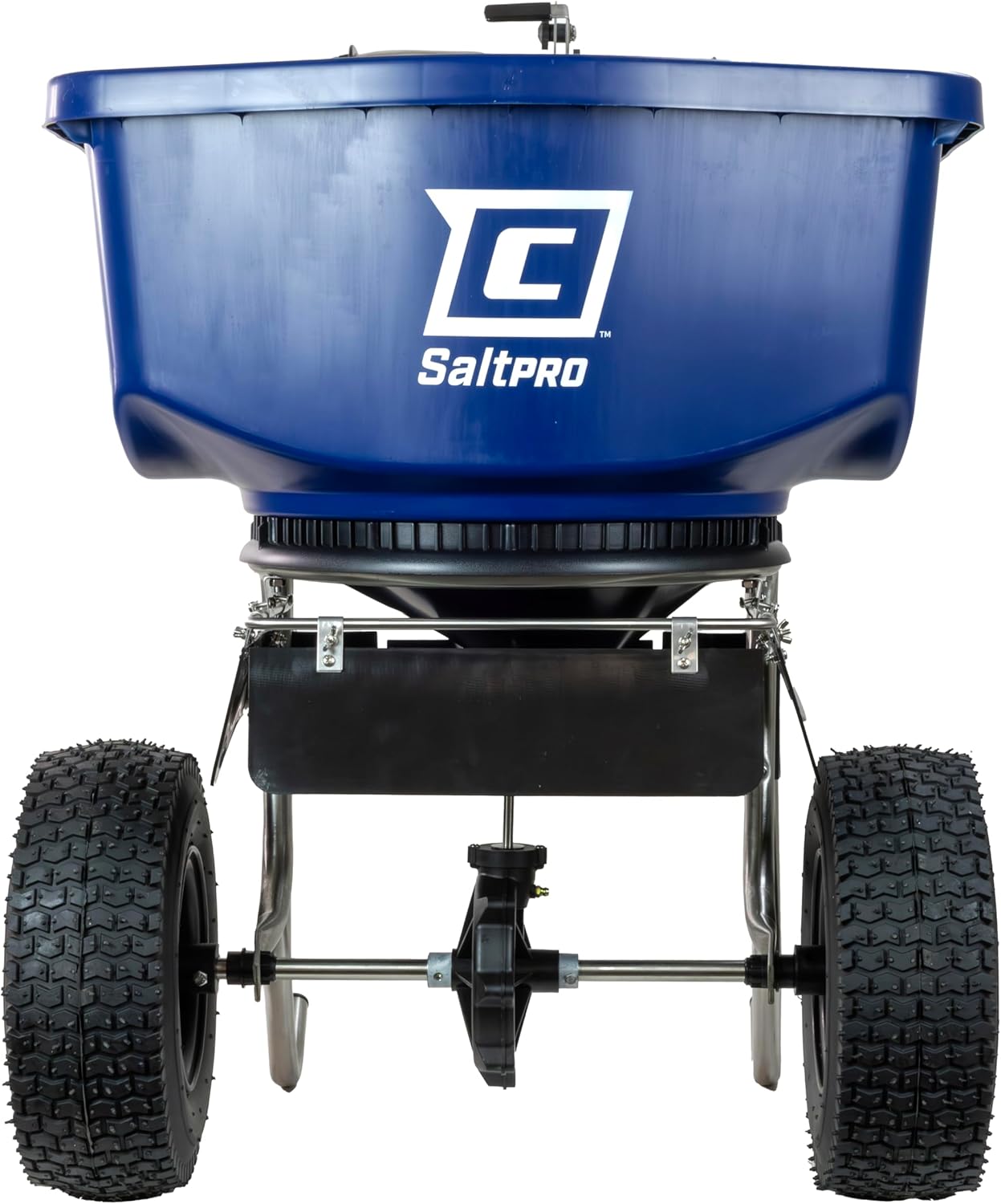 Chapin 88800B 100-Pound Salt Spreader |
8.4/10 | Buy |
| Best Value |
 VEVOR TC2034B 100-lb Broadcast Spreader |
8.1/10 | Buy |
 SaltDogg WB155BG 100 lb Walk Behind Salt Spreader |
7.6/10 | Buy | |
 Buyers Products 3039632R 100 lb All-Season |
7.5/10 | Buy |
Scotts Whirl Hand-Powered Spreader
The Scotts Whirl is a compact handheld spreader designed for small yards and spot treatments. It simplifies spreading grass seed, fertilizer, salt, and ice melt with its smooth, even output and adjustable arm support, and it arrives fully assembled. Perfect for quick touch-ups or seasonal maintenance without hauling a large walk-behind unit.
Pros
- Lightweight and comfortable, adjustable arm support reduces strain during use.
- Handles seed, fertilizer, salt, and ice melt for year-round lawn care.
- Fully assembled out of the box, no setup required.
Cons
- Limited 1,500 sq ft capacity and manual operation make it less suitable for large lawns.
Scotts Turf Builder EdgeGuard DLX Broadcast
Use the Scotts Turf Builder EdgeGuard DLX Broadcast Spreader to apply fertilizer, grass seed, granular weed killer, salt, and ice melt. This reliable spreader option for lawns comes pre-calibrated and ready-to-use, and holds up to 15,000 sq. ft. of Scotts product. When EdgeGuard is engaged, it will block off the right-side of the spreader pattern to prevent product from spreading onto non-lawn areas. Using the Scotts Turf Builder EdgeGuard DLX Broadcast Spreader is simple. To begin, turn rate control dial to the correct setting listed on the back of each Scotts product, pour the product in the hopper, then start spreading. The grass seed spreaders for lawns feature design enhancements like a curved hopper and dual-bladed agitator for smooth product funneling and consistent coverage. These fertilizer spreaders provide uniform coverage of granular products; without one, you may end up with uneven coverage of fertilizer or control products that can result in uneven feeding, weed, disease, or insect control. As a trusted Scotts spreader for lawns, DIY homeowners can also use it as an ice melt spreader to distribute salt on walkways and driveways.
Chapin 88800B 100-Pound Salt Spreader
Built for contractors and commercial use, the Chapin 88800B is a rugged 100-pound salt spreader with a weather-resistant poly hopper and a spiked auger that breaks up clumps. Its adjustable baffles allow precise control over the spread pattern, while 12-inch pneumatic tires and an enclosed gear system provide reliable traction and durability on icy surfaces. This model also features an ergonomic T-shaped handle for comfortable operation, even with gloves.
Pros
- Weather-resistant poly hopper and enclosed gear system withstand ice melt and moisture
- Adjustable front and side baffles for precise spread pattern control
- 12-inch pneumatic tires offer good traction on snow and ice
- Spiked auger effectively breaks up clumps to prevent clogging
- Ergonomic T-shaped handle with comfortable grip, suitable for gloved use
Cons
- Heavy at nearly 39 pounds, may be cumbersome for some users to maneuver
VEVOR TC2034B 100-lb Broadcast Spreader
The VEVOR TC2034B is a walk-behind spreader built for medium to large lawns. Its 100-pound hopper minimizes refill stops, and the 13-inch pneumatic tires provide stable rolling over uneven ground. Pre-installed key components simplify setup, while the 30-scale control system allows fine-tuning of spread rate for fertilizer, seed, or ice melt.
Pros
- Large 100-lb hopper reduces refill frequency
- 13-inch all-terrain tires handle rough surfaces
- Pre-installed parts speed up assembly
SaltDogg WB155BG 100 lb Walk Behind Salt Spreader
The SaltDogg WB155BG is a 100 lb walk behind broadcast spreader with a steel frame, designed for clearing sidewalks, walkways, and small lots. Owner reviews describe it as sturdy and say it throws salt well once moving, though it takes some effort to push when the hopper is full. It suits small businesses that handle their own salting as well as homeowners with larger pavement.
Pros
- 100 lb hopper capacity for walk behind use
- Steel frame adds durability
- Owner reviews describe it as sturdy and effective at throwing salt
Cons
- Hard to push when fully loaded, especially at the start
- One owner reported the stand and salt lever broke on the second use, raising durability concerns
Buyers Products 3039632R 100 lb All-Season
Handle year-round grounds maintenance with the Buyers Products 3039632R Grounds Keeper Walk-Behind Broadcast Spreader. Built for property managers, contractors, institutions, and demanding residential users, this versatile spreader carries up to 100 lb of compatible material for efficient coverage with fewer refills. Use it for grass seed and fertilizer in warmer seasons, then transition to bagged salt or ice melt when winter conditions arrive. The axle-driven spinner distributes material across a pattern up to 24 feet wide, while the simple flow-control lever and adjustable poly deflectors help direct material and reduce unwanted application near garden beds, curbs, or surrounding surfaces. A rust-resistant poly hopper pairs with a fully welded, powder-coated carbon steel frame for dependable service. The enclosed gearbox, grease fitting, and commercial-grade alloy gears help protect the drive system from weather, rust, and cold. Large 13-inch pneumatic tires support smooth movement across varied terrain. A hopper screen and nylon rain cover are included to help maintain material flow and protect the load. Before use, confirm the spinner-disc set screw is tight, adjust the flow for the selected material, and follow the material manufacturer's application guidance. Empty and rinse the spreader after using salt, ice melt, or fertilizer to reduce corrosive residue.
Best Salt Spreader for Commercial Use Buying Guide
Hopper Capacity and Material
For commercial applications, capacity is a primary concern. A larger hopper means fewer refills and more time covering ground. Look for models with at least 80, 100 lb capacity if you are handling medium to large areas.
The hopper material also matters: polyethylene is lightweight and rustproof, while steel offers greater durability under heavy use and rough treatment.
Some units feature a grated top to prevent large clumps from clogging the mechanism, a thoughtful detail for icy conditions.
If you frequently clear extensive surfaces, pairing your spreader with a powerful two-stage snow blower for gravel driveways can further speed up your workflow.
Spreading Width and Pattern Control
The spread pattern directly affects how evenly you cover a surface. Broadcast spreaders typically cover a wide swath, making them ideal for open lots, while drop spreaders offer more precision for sidewalks and narrow paths.
Many commercial-grade walk-behind models allow you to adjust the spread width from a few feet up to 30 feet or more. Look for an adjustable flow gate or a variable-speed spinner to fine‑tune the application rate.
This control helps you avoid waste and ensures consistent coverage, which is especially important when using expensive ice melt products.
Frame Construction and Wheel Quality
A salt spreader for commercial use must withstand repeated loading, vibration, and exposure to corrosive salt. A reinforced steel frame with a powder‑coat finish resists rust and impact better than lighter plastic frames.
Pneumatic tires (air‑filled) provide better traction on uneven, icy, or snowy terrain compared to solid rubber wheels. Larger wheels also make it easier to push the spreader over soft ground or through slush.
For heavy snow conditions, a sturdy spreader works well alongside a snow blower designed for heavy wet snow to complete the job.
Ease of Assembly and Maintenance
Commercial operators value equipment that is quick to assemble and easy to maintain. Look for models with tool‑free assembly, clear instructions, and readily available replacement parts.
Features like a removable hopper, accessible gearbox, and sealed bearings simplify cleaning and prolong the life of the spreader. Many top‑rated units include a protective cover or storage position for the flow control rod.
Regular maintenance, such as rinsing after each use and lubricating moving parts, will keep your spreader performing season after season.
Portability and Storage
Even commercial spreaders need to be moved between sites and stored compactly. Foldable handles, collapsible hoppers, and stackable designs are valuable if you have limited truck or shed space.
Hand‑powered or handheld spreaders are the most portable but are best suited for small areas or spot treatments. For larger operations, a walk‑behind model with a folding handle saves space and makes transport easier.
If you manage multiple properties, consider keeping a compact spreader in your vehicle alongside a battery‑powered snow blower for quick clearing.
Budget and Value Considerations
Prices for commercial salt spreaders range from under $24.99 to over $365.47, depending on capacity, build quality, and brand reputation.
While a higher upfront cost often correlates with better durability and features, there are solid mid‑range options that deliver excellent value. Determine your typical coverage area and frequency of use before deciding how much to invest.
For occasional use or small lots, a budget‑friendly model may suffice, but daily commercial use demands a rugged machine that can handle the abuse.
Why You Should Trust Us
Snow Removal Wiki is an independent review site that evaluates products through a transparent, research‑driven process. We do not conduct our own product trials; our evaluations are grounded in research, published data, expert review consensus, and verified buyer feedback.
Each product is scored on a 0, 10 SRW Score based on a consistent set of criteria relevant to its category. Our goal is to provide you with trustworthy, actionable recommendations so you can make an informed purchase.
All reviews are affiliate‑supported, but this does not influence our rankings or editorial content.
Final Thoughts
- Best Overall: Scotts Whirl Hand-Powered Spreader, With the highest SRW Score in our lineup, this handheld model offers exceptional precision and ease of use for targeted applications, making it a top choice for commercial operators who need quick, accurate salt distribution on smaller lots.
- Best for Large Areas: Buyers Products 3039632R 100 lb Walk-Behind Broadcast Spreader, Its 100‑lb capacity and wide broadcast pattern cover expansive parking lots efficiently, backed by a sturdy steel frame that stands up to heavy use.
- Best Value: VEVOR Broadcast Spreader 100 lbs, Offering a generous hopper, pneumatic tires, and a low price point, this walk‑behind spreader delivers professional‑grade performance without breaking the bank.
- Best Professional Grade: SaltDogg WB155BG Professional 100 lb Walk Behind Salt Spreader, Built with a reinforced steel frame and precision flow control, this model is designed for daily commercial use and demanding winter conditions.
- Best Walk‑Behind: CHAPIN 88800B SaltPro 100-Lb Contractor Salt & Ice Melt Spreader, Combines a large hopper with a reliable gear‑driven mechanism and easy‑to‑adjust spread pattern, ideal for contractors who need consistent performance shift after shift.
Frequently Asked Questions
How do I choose between a broadcast and a drop spreader for commercial use?
Broadcast spreaders are best for covering large, open areas quickly because they fling material in a wide arc. Drop spreaders deposit salt directly below the hopper, offering more precision for sidewalks, driveways, and narrow paths.
For commercial use, a broadcast spreader is usually the better choice for parking lots and large surfaces, while a drop spreader works well for walkways and areas near landscaping.
Can I use a salt spreader for fertilizer or grass seed?
Yes, many spreaders are multi‑purpose and can handle salt, fertilizer, seed, and ice melt. However, you should thoroughly clean the hopper and mechanism between uses to avoid chemical reactions or cross‑contamination.
Some models, like the Scotts Turf Builder EdgeGuard, are specifically designed for both lawn products and ice melt, making them versatile for year‑round use.
How much salt does a commercial spreader typically hold?
Commercial walk‑behind spreaders usually have hoppers ranging from 80 to 150 pounds. Hand‑powered or handheld models hold less, often between 10 and 25 pounds.
The right capacity depends on the size of the area you need to treat and how often you are willing to refill. For large parking lots, a 100‑lb hopper is a good baseline.
What maintenance does a salt spreader require?
After each use, rinse the hopper, spinner, and frame with fresh water to remove salt residue, which can cause corrosion. Lubricate moving parts like the gearbox and wheel bearings at the start and end of each season.
Check for worn or damaged components, and store the spreader in a dry place. Regular maintenance extends the life of your equipment significantly.
Are pneumatic tires necessary for a commercial salt spreader?
Pneumatic tires provide better traction and a smoother ride over uneven, icy, or snowy surfaces compared to solid tires. They also absorb shock, reducing strain on the frame.
If you will be using the spreader on rough terrain or soft ground, pneumatic tires are highly recommended. For flat, paved surfaces, solid tires may suffice and require less maintenance.
How do I ensure even salt distribution?
Start by calibrating the spreader according to the manufacturer’s instructions for the specific material you are using. Walk at a consistent, moderate pace and overlap your passes slightly to avoid gaps.
Adjust the flow gate or spinner speed based on the desired application rate. Practicing on a small area first helps you dial in the settings before covering large sections.
About the author

Harry writes reviews and buying guides for Snow Removal Wiki.