
The Best Riding Mower Salt Spreader
We researched top tow-behind spreaders for salt and ice melt on riding mowers. Evaluate capacity, spread width, corrosion resistance, and value to find the best model for clearing snow efficiently.
 By Harry
Updated October 10, 2026
If you maintain a large driveway, parking area, or commercial property, using a riding mower to spread salt and ice melt during winter can save hours of manual labor.
A dedicated riding mower salt spreader transforms your lawn tractor into an efficient winter maintenance machine, allowing you to cover wide paths with consistent distribution.
However, not all spreaders handle the corrosive effects of salt equally, and factors like hopper material, spread width, and hitch compatibility directly impact long-term performance.
In this guide, we help you choose the best riding mower salt spreader by analyzing specifications, expert review consensus, and verified buyer feedback.
We evaluated each model against consistent criteria and scored it on our 0 to 10 SRW Score to highlight the most reliable and practical options. Below are our top picks, followed by a detailed buying guide to steer your decision.
| Award | Product | SRW Score About SRW ScoreThe SRW Score is our own rating from 0 to 10, based on performance, design and build, ease of use, and value. It reflects independent research and is never influenced by manufacturers, retailers, or affiliate commissions. Learn more › | |
|---|---|---|---|
| Best Overall |
 Brinly BS26BH-A Tow Behind Broadcast Spreader |
8.3/10 | Buy |
| Best Value |
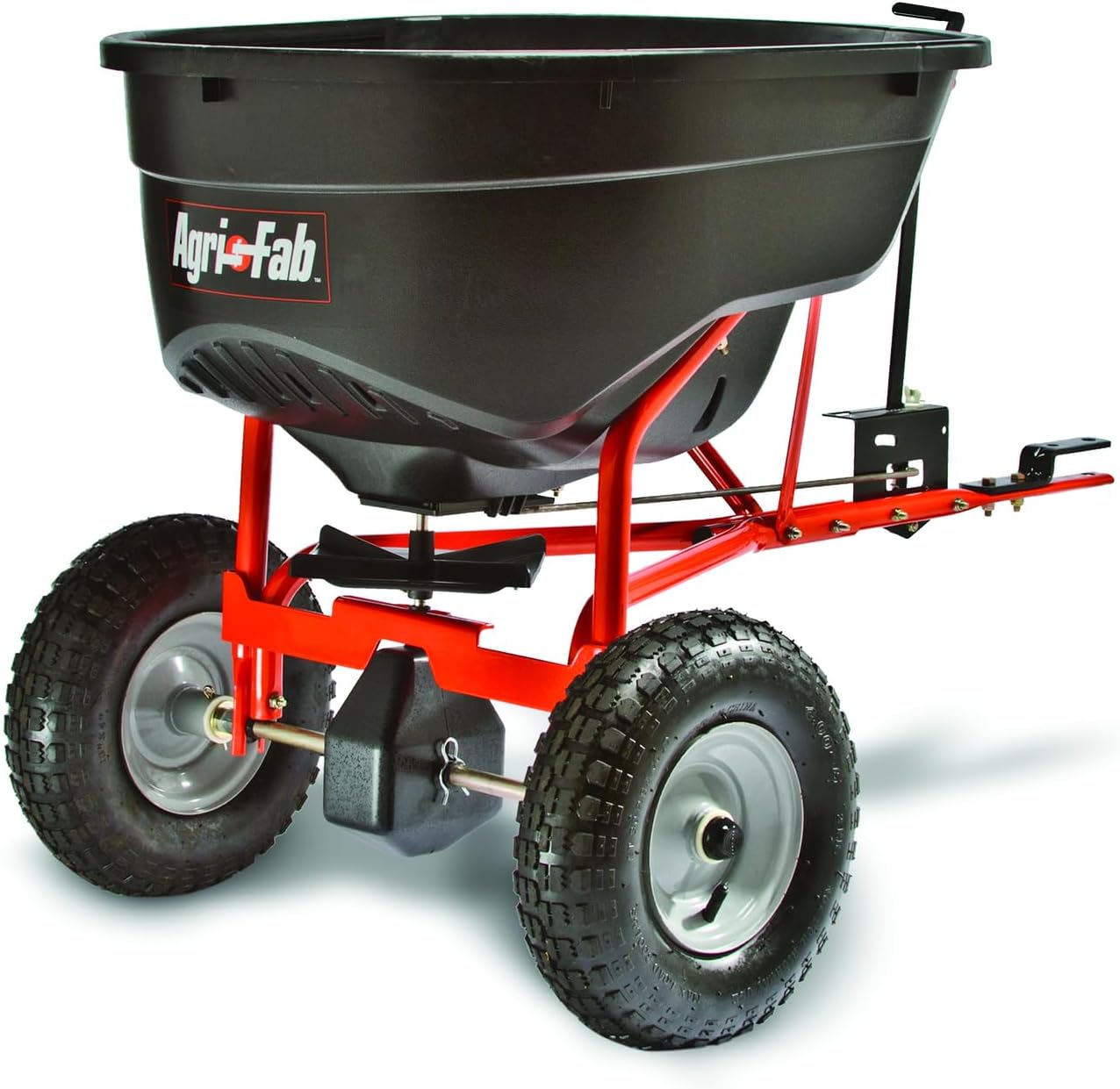 Agri-Fab 45-0463 130-lb Tow Spreader |
8.1/10 | Buy |
Brinly BS26BH-A Tow Behind Broadcast Spreader
Brinly’s BS-26BH tow-behind broadcast spreader makes it easy to attain a dense, green yard. Its large rust-proof polyethylene hopper holds 2.5 cubic feet (125 lbs.) of material, making it ideal for homeowners with lawns ½ acre and larger. Use your spreader every season of the year to apply grass seed, fertilizers, pesticides, insecticides, fungicides, even sand and ice melting agents. Regular lawn feeding, weed control, overseeding and pest elimination help keep your lawn healthy, vibrant and growing strong. Regular fertilization, annual seeding and eliminating harmful insects allows your lawn’s root system to grow thicker, crowding out opportunistic weeds and giving it the resilience it needs to survive the stresses of heat, drought and foot traffic. The tubular steel frame, powder-coat finish, enclosed nylon gears and stainless steel interior hardware prevent rust and corrosion. The patented Directional Spread Pattern Control feature allows the user to adjust for different particle sizes and weights, providing uniform coverage for a beautiful stripe-free lawn. Like it’s larger brother the BS36BH broadcast spreader, the BS-26BH uses our Autoflow™ design to automatically stop the flow of material when you stop your mower, eliminating waste and turf burn from overapplication.
Agri-Fab 45-0463 130-lb Tow Spreader
The Agri-Fab 45-0463 is a pull-behind broadcast spreader built for riding mowers and lawn tractors. Its 130-pound hopper covers up to 25,000 square feet per fill, and the adjustable steel rod flow control delivers a consistent 10- to 12-foot spread. This is a versatile seasonal tool for handling seed, fertilizer, salt, and ice melt on larger properties.
Pros
- 130-pound hopper covers up to 25,000 sq ft per fill
- Universal hitch fits most riding mowers and lawn tractors
- Spreads seed, fertilizer, salt, and ice melt for year-round use
- Pneumatic tires and steel frame handle rough terrain
Cons
- Some buyers report corrosion quickly developing if not cleaned promptly
- Factory quality control can vary, with occasional reports of gearbox issues or missing hardware
- Assembly is straightforward but gears and moving parts may need extra lubrication
Riding Mower Salt Spreader Buying Guide
Hopper Capacity and Material
Hopper size determines how much salt or ice melt you can carry before refilling. For most residential uses, 100 to 130 pounds is adequate to cover half an acre without stopping.
Larger properties benefit from higher capacities, but heavier loads also affect mower handling and fuel efficiency. Material matters most: poly hoppers resist corrosion far better than painted steel when exposed to salt, and they are lighter to mount and remove.
Check whether the hopper includes a lid or cover to keep dry products from clumping. Some spreaders offer translucent hoppers that let you see the material level at a glance.
When comparing options, prioritize polyethylene or UV-stabilized resin hoppers for long-term durability, especially if you store the spreader in a damp environment.
Spread Width and Pattern Control
Broadcast spreaders throw material in a wide arc, covering up to 12 feet or more per pass. This reduces the number of trips across your driveway but requires careful overlap to avoid streaks.
Adjustable spread pattern controls let you narrow the coverage for walkways or widen it for large parking areas. Look for models with a clearly marked dial or lever that ranges from light to heavy application.
For salt and granular ice melt, a spread width of 10 to 12 feet is optimal for most riding mowers. Wider patterns may cause uneven distribution on windy days, while narrower patterns increase application time.
A good spreader will include a calibration chart for common materials, allowing you to match the gate setting to your desired pounds per square foot.
Hitch Compatibility and Setup
Nearly all tow-behind spreaders use a universal hitch pin that fits standard lawn tractor hitches, including sleeve-style and clevis-pin hitches. Before purchasing, confirm that your riding mower has a receiver tube or drawbar that accepts the spreader’s hitch.
Some spreaders include an adapter kit for quick attachment, while others require a separate purchase for different hitch styles.
Easy setup saves frustration: look for models with tool-free assembly, a single pivot point for folding the handle (if applicable), and wheels that mount without specialized tools.
A well-designed spreader also stays level when attached, preventing premature wear on the distribution mechanism. If you plan to switch between mowing and spreading frequently, a quick-disconnect hitch is worth the premium.
Corrosion Resistance and Durability
Salt accelerates rust on metal components, so the best riding mower salt spreader uses corrosion-resistant materials throughout. Poly hoppers, coated framework, and stainless steel hardware are hallmarks of a winter-ready spreader.
Some manufacturers apply a powder-coat finish to the frame for added protection. Check user feedback for reports of chipping or rust after one season, especially around wheel hubs and the gate assembly.
Regular rinsing with fresh water after each use is essential, but a durable spreader withstands occasional neglect. Models with sealed bearings on the wheels and the agitator shaft reduce maintenance and extend service life.
Reading verified buyer feedback can reveal common failure points, helping you avoid models that degrade after a single winter.
Controls and Ease of Use
Intuitive controls make a big difference when spreading in cold weather.
The primary control is the on/off flow gate, which should be easily reachable from the mower seat, either via a pull cable that mounts near the steering wheel or a lever on the hopper.
Some spreaders offer a remote control that mounts to the fender, allowing you to start and stop flow without looking back.
Additional features like a spread pattern deflector or a selective shut-off help avoid scattering material onto flowerbeds or lawns. Agitator blades that break up clumps prevent clogging during damp conditions.
A spreader that is simple to operate reduces the learning curve and increases the likelihood you will use it consistently throughout the winter.
Maintenance and Winter Storage
Even the best riding mower salt spreader requires some care to stay reliable. After each use, empty the hopper and rinse away any remaining salt residue, then allow it to dry completely before storing.
Lubricate pivot points and wheel bearings with a light oil or silicone spray to prevent seizure. If the spreader sits unused for months, store it in a dry garage or under a cover to protect it from the elements.
Some spreaders come with a replaceable spreader plate, which is a wear item that you can swap out after heavy use. Check your owner’s manual for recommended seasonal tasks.
A spreader that is easy to disassemble for cleaning and that uses common fasteners will be simpler to maintain. For more tips on maintaining winter gear, see our snow blower accessories guide.
Why You Should Trust Us
Snow Removal Wiki is an independent review site that specializes in snow-handling equipment. Every product we recommend earns a SRW Score on a 0-to-10 scale, calculated by applying a consistent evaluation methodology.
We do not conduct our own product trials; our evaluations are grounded in research, published data, expert review consensus, and verified buyer feedback.
Our purchasing guide and final rankings are based on hours of analyzing specifications and comparing real-world user experiences. We disclose affiliate relationships in compliance with FTC guidelines, and our editorial decisions remain independent of manufacturers or retailers.
Our goal is to provide transparent, actionable advice that respects your time and budget.
Final Thoughts
Best Overall: Brinly BS26BH-A Tow Behind Broadcast Spreader. With a 125-pound poly hopper, a 12-foot spread width, and a corrosion-resistant frame, the Brinly earned the highest SRW Score in our research.
Buyers consistently praise its easy hitch setup and smooth, consistent spread pattern, making it the most reliable choice for mid-sized properties.
Best Value: Agri-Fab 130-Pound Pull-Behind Broadcast Spreader. This model offers an even larger hopper capacity at a lower price point, with an 8.1 SRW Score reflecting strong performance for its cost.
Its steel frame is powder-coated for corrosion resistance, and the 12-foot spread width keeps application efficient. Ideal for budget-conscious owners covering larger driveways.
Frequently Asked Questions
Can I use a riding mower salt spreader for other materials like fertilizer?
Yes, most broadcast spreaders designed for ice melt also work with dry fertilizer, grass seed, and granular herbicides. However, you should thoroughly clean the hopper and spreader mechanism between uses to avoid chemical reactions or cross-contamination.
If you switch materials frequently, consider a spreader with a removable hopper for easier cleaning.
How do I calibrate my spreader for salt application?
Calibration ensures you apply the correct amount per square foot. Fill the hopper with a measured amount of salt, mark a starting point, and drive a known distance at your normal speed.
Weigh the remaining salt to calculate your application rate. Consult the spreader’s manual for recommended gate settings, usually between 4 and 6 for ice melt. Adjust the setting and repeat until you achieve the desired coverage.
Will a tow-behind spreader fit any riding mower?
Most modern riding mowers and garden tractors come with a standard 2-inch or 1.25-inch hitch receiver that accepts a universal hitch pin. The spreaders in our review include a universal hitch (usually 5/8-inch pin) that fits most models.
Verify your mower’s hitch type before buying, if you have an older or compact mower, a sleeve hitch adapter may be needed. Check the product specs for hitch compatibility details.
How do I prevent rust and corrosion from salt?
After every use, rinse the spreader thoroughly with fresh water, paying close attention to the gate, spreader plate, and wheel hubs. Dry the spreader with a cloth or allow it to air dry before storing in a dry location.
Apply a light coating of silicone spray or WD-40 to metal surfaces and pivot points. Spreaders with poly hoppers naturally resist corrosion better than steel models, but the metal frame still requires care.
What size spreader do I need for my driveway?
Measure the area you typically treat in one session. For a standard 20-foot by 100-foot driveway (about 0.05 acres), a 100- to 130-pound hopper is more than sufficient.
For larger surfaces, apartment complexes, parking lots, or long rural lanes, consider a spreader with a 150-pound or higher capacity to minimize refill stops. The spread width also matters: 12 feet is a good middle ground for efficiency without overshooting edges.
Can I mount a salt spreader permanently to my mower?
Permanent mounting is possible, but it may limit the mower’s use for other tasks like towing a cart or aerator. Most tow-behind spreaders are designed for seasonal attachment and disassembly.
If you prefer a semi-permanent setup, you can leave the hitch bracket in place and simply drop the spreader into the receiver when needed. Quick-connect hitch systems make swapping attachments fast without tools.
About the author

Harry writes reviews and buying guides for Snow Removal Wiki.